Bernanke: Fed Sees Slower Growth, Uptick in Inflation
CNBC
In his first regular news conference, Federal Reserve Chairman Ben Bernanke said the central bank was continuing its stimulus policy because it was projecting slower growth in the economy with only a modest uptick in inflation.
In his first regular news conference, Federal Reserve Chairman Ben Bernanke said the central bank was continuing its stimulus policy because it was projecting slower growth in the economy with only a modest uptick in inflation...[Full Article]

Showing posts with label inflation. Show all posts
Showing posts with label inflation. Show all posts
Thursday, April 21, 2011
McDonald's warns of higher food inflation
Reuters
Reuters
...McDonald's and other restaurant operators are getting squeezed by accelerating food costs and must figure out how to raise prices without scaring away already skittish diners.
"It's very hard to pass through price increase right now," said Stifel Nicolaus analyst Steve West.
McDonald's Chief Executive Jim Skinner said customers are getting "pinched everywhere. They should not suffer the same fate at McDonald's."
Chief Financial Officer Pete Bensen said the company would sacrifice some short-term margin to protect long-term growth. He added that McDonald's has experience finding the right recipe for price increases in fragile economic times.
McDonald's now expects food costs to rise between 4 percent and 4.5 percent in the United States and Europe this year. That is up from its prior call for a rise of 2 percent to 2.5 percent in the United States and an increase of 3.5 percent to 4.5 percent in Europe.
McDonald's in March put through a 1 percent menu price rise in the United States, where it plans additional increases. Prices in Europe are up by the same amount and the company plans to raise prices in China...[Full Article]

Friday, April 1, 2011
Beef prices soar
CNN Money
CNN Money
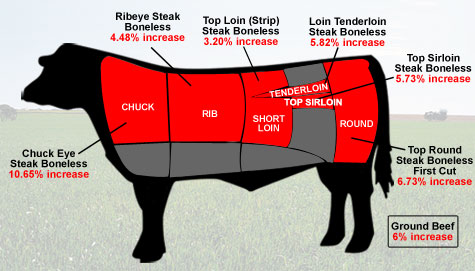
NEW YORK (CNNMoney) -- If you're already shocked by how much your favorite cut of beef costs at the supermarket, brace yourself because prices will keep going up.
Surging commodity prices already have consumers paying more for groceries such as eggs, milk, cereal and meat. The price of beef in particular has shot through the roof.
In February, the average retail price per pound for beef was $3.87, up 12.4% versus a year ago, according to market research firm FreshLook Data...[Full Article]
Thursday, March 31, 2011
Wal-Mart CEO Bill Simon expects inflation
USA Today
U.S. consumers face "serious" inflation in the months ahead for clothing, food and other products, the head of Wal-Mart's U.S. operations warned Wednesday.
USA Today
U.S. consumers face "serious" inflation in the months ahead for clothing, food and other products, the head of Wal-Mart's U.S. operations warned Wednesday.
The world's largest retailer is working with suppliers to minimize the effect of cost increases and believes its low-cost business model will position it better than its competitors.
Still, inflation is "going to be serious," Wal-Mart U.S. CEO Bill Simon said during a meeting with USA TODAY's editorial board. "We're seeing cost increases starting to come through at a pretty rapid rate."...[Full Article]
Saturday, March 26, 2011
Consumers have a beef with Fed over inflation
Financial Times
Food riots, deposed Middle Eastern despots and now this? Last week, a Texas man brandishing an assault rifle was involved in a three-hour shoot-out with police and had to be subdued with tear gas after ordering seven Beefy Crunch Burritos at a Taco Bell drive-through and being informed that their price had risen from 99 cents to $1.49.
Financial Times
Food riots, deposed Middle Eastern despots and now this? Last week, a Texas man brandishing an assault rifle was involved in a three-hour shoot-out with police and had to be subdued with tear gas after ordering seven Beefy Crunch Burritos at a Taco Bell drive-through and being informed that their price had risen from 99 cents to $1.49.
Late night comedians and serious pundits alike had a field day with the story, opining on issues like fast-food culture, obesity (the seven burritos contain 3,600 calories, double the recommended daily intake) and gun control.
With his petty gripe, the gunman, Ricardo Jones, is no Muhammad al Bouazizi, the self-immolating Tunisian fruit seller who inspired millions across the region to throw off the yoke of tyranny, but 50 per cent is 50 per cent in San’a or San Antonio. Food inflation is a global phenomenon.
Taco Bell may well not be the villain here. It was recently alleged in a class-action lawsuit that only 35 per cent of what the fast-food chain describes as “beef” meets the strict technical definition (meat from a cow). The remaining 65 per cent is claimed to be made from fillers such as potassium lactate, modified corn starch, malto-dextrin and autolyzed yeast extract. Taco Bell has said it vigorously disputes the allegations made about its food – but if the class action claims were proved to be true, it could be seen as an ingenious attempt to hold the line on meat price rises. However, it is not only the price of meat that is rising alas, but also fuel, flour, vegetables and even autolyzed yeast extract.
The finger of blame is increasingly pointing toward central banks and the US Federal Reserve in particular. By printing money through quantitative easing, there are supposedly more dollars, yen and pounds chasing the same number of Beefy Crunch Burritos. Fed chairman Ben Bernanke actually was asked during a speaking engagement last month whether the central bank was culpable for the revolution in Egypt...[Full Article]
Tuesday, February 1, 2011
Gas prices could increase because of political unrest overseas
WRBL News
The General Manager of Fletcher oil company said he doesn’t believe the rumors that gas will get to four or five dollars a gallon but if he had to take a guess he said if political unrest continues or something catastrophic happens, he thinks gas could get to $3.50 a gallon.
WRBL News
The General Manager of Fletcher oil company said he doesn’t believe the rumors that gas will get to four or five dollars a gallon but if he had to take a guess he said if political unrest continues or something catastrophic happens, he thinks gas could get to $3.50 a gallon.
“The Suez Canal runs through Egypt it's a main shipping channel and just from all the unrest going on in Egypt could have an influx on that shipping channel which would cause prices to spike.” Said Gary Buschman, G.M. of Fletcher oil...
[Full Article]
Saturday, January 29, 2011
Food Prices Expected to Rise in 2011
Tensions rise on surging food prices
Farmers warn of food price rises
Higher food prices coming, Metro says
The Star
...Sparked by Wal-Mart’s continuing expansion into grocery – 40 more stores are coming this year – this kind of retail competition, along with a higher Canadian dollar, has so far spared Canadian consumers the kind of food price inflation that threatens to erupt in violence in other parts of the world.
NEW YORK (CNNMoney) -- Food prices have been rising worldwide, as the cost of raw materials and agricultural products surge, contributing to political unrest around the globe.
In December, international food prices broke an all-time high when they rose 25% for the year, led by rising costs for staples like rice, wheat, and maize, the United Nations reported...
[Full Article]Farmers warn of food price rises
BBC
Big rises in food prices are likely over the next year, livestock farmers in Suffolk have told the BBC Politics Show in the East.
The farmers said the rises were likely because of the increased cost of breeding chickens and pigs, due to an increase in the price of feed.
This is partly due to the rise in demand for livestock feed from China.
Farmers told the BBC that the increased cost of feed had not yet been passed on to the consumer.
Pig farmer Peter Mortimer, who has 250 sows at Metfield in Suffolk, said: "It's unsustainable (not to pass on the costs), quite honestly, if we don't get an increase in prices before long, the industry faces a disastrous situation.
"Give it six months on and we will be in despair. I think that whole industry would if we don't get the extra money from the market place. Unfortunately I think it's the end of cheap food."...
[Full Article]Higher food prices coming, Metro says
The Star
...Sparked by Wal-Mart’s continuing expansion into grocery – 40 more stores are coming this year – this kind of retail competition, along with a higher Canadian dollar, has so far spared Canadian consumers the kind of food price inflation that threatens to erupt in violence in other parts of the world.
But Canadians can expect to see more food price increases in supermarkets soon, the country’s third-largest food retailer predicted this week.
“We do expect some cost increases to be processed through the system starting in February,” Eric La Flèche, president and chief executive officer of Metro Inc., told analysts on a conference call on Wednesday...
[Full Article]
Thursday, January 27, 2011
Grocery prices skyrocket faster than official inflation
(NaturalNews) Grocery prices increased at more than 50 percent the rate of inflation in 2010, according to data from the U.S. Bureau of Labor Statistics.
Food prices increased an average of 1.7 percent between November 2009 and November 2010, in comparison with a general inflation rate of only 1.1 percent. The greatest price increases were seen among meat, poultry, fish and eggs, which went up in cost by 5.8 percent. The price of sugar and sweets increased 1.2 percent, the price of fats and oils increased 3 percent and the price of dairy-based products increased 3.8 percent.
The only commodities to go up in price more than food were medical care and transportation.
"I noticed just this month that my grocery bill for the same old stuff -- cereal, eggs, milk, orange juice, peanut butter, bread -- spiked $25," said Sue Perry, deputy editor of "ShopSmart" magazine. "It was a bit of sticker shock."
The rises in price were caused in part by climate-related crop failures in several major food exporting countries. In addition, rising demand for corn from the biofuels industry has pushed up prices for animal feed, leading to higher meat, dairy and egg costs. Finally, rising fuel prices have increased food production and transportation costs as well.
Prices are only likely to keep rising. The Department of Agriculture has forecast a further 3 percent rise in food prices in 2011, but openly admits that the estimate is conservative.
"The USDA always plays it safe," said Wells Fargo agricultural economist Michael Swanson. Swanson predicted price increases of 4 percent, the highest since the 5.5 percent increases that led to riots worldwide in 2008.
Major food producers including Kraft and General Mills have already announced plans to increase the prices of their products. Just how much of that increase will be passed along to consumers is uncertain, as retailers may try to force prices lower to keep shopper volume high.
"Food is a high-frequency driver," Swanson said. "So if stores like Walmart and Kmart want to get shoppers in the door, it's to their benefit to keep prices low."
Sources for this story include: http://www.sfgate.com/cgi-bin/artic....
(NaturalNews) Grocery prices increased at more than 50 percent the rate of inflation in 2010, according to data from the U.S. Bureau of Labor Statistics.
Food prices increased an average of 1.7 percent between November 2009 and November 2010, in comparison with a general inflation rate of only 1.1 percent. The greatest price increases were seen among meat, poultry, fish and eggs, which went up in cost by 5.8 percent. The price of sugar and sweets increased 1.2 percent, the price of fats and oils increased 3 percent and the price of dairy-based products increased 3.8 percent.
The only commodities to go up in price more than food were medical care and transportation.
"I noticed just this month that my grocery bill for the same old stuff -- cereal, eggs, milk, orange juice, peanut butter, bread -- spiked $25," said Sue Perry, deputy editor of "ShopSmart" magazine. "It was a bit of sticker shock."
The rises in price were caused in part by climate-related crop failures in several major food exporting countries. In addition, rising demand for corn from the biofuels industry has pushed up prices for animal feed, leading to higher meat, dairy and egg costs. Finally, rising fuel prices have increased food production and transportation costs as well.
Prices are only likely to keep rising. The Department of Agriculture has forecast a further 3 percent rise in food prices in 2011, but openly admits that the estimate is conservative.
"The USDA always plays it safe," said Wells Fargo agricultural economist Michael Swanson. Swanson predicted price increases of 4 percent, the highest since the 5.5 percent increases that led to riots worldwide in 2008.
Major food producers including Kraft and General Mills have already announced plans to increase the prices of their products. Just how much of that increase will be passed along to consumers is uncertain, as retailers may try to force prices lower to keep shopper volume high.
"Food is a high-frequency driver," Swanson said. "So if stores like Walmart and Kmart want to get shoppers in the door, it's to their benefit to keep prices low."
Sources for this story include: http://www.sfgate.com/cgi-bin/artic....
Monday, January 17, 2011
Rising Food Cost and Food Riots
Grocery store prices likely to rise
Chicago Sun-Times
Look Out For Rising Grocery Prices
Corn and soybeans expected to reach high costs this year
NBC Chicago
'Explosive' Food Prices the Biggest Risk: Analyst
CNBC
Overheating emerging markets, in China in particular, pose the biggest threat to the market and political situation in 2011 according to Philippe Gijsels, head of research at BNP Paribas Fortis Global Markets.
“These economies are clearly overheating and governments are putting measures in place to slow them down to fight inflationary pressure. More than anything else, food inflation is a problem," Gijsels told CNBC.com.
"Nowhere to Hide" from Rising Food Prices
Expect to Pay More for Meat, Many Fruits, Veggies, Restaurant Offerings
(CBS) NEW YORK -- Don't look now, but inflation is expected to hit food hard this year.
"Corn is a big one" in the higher prices department, Bloomberg Businessweek Assistant Managing Editor Sheelah Kolhatkar told "Early Show on Saturday Morning" co-anchor Betty Nguyen. "The Agriculture Department released a report a couple of days ago about crop forecasts for the year and predicted corn production is going to go down very significantly, which led to a spike in prices."
Why corn's rise?
"There are a lot of reasons," Kolhatkar replied. "Weather is cited as a big one. There's been sort of freak weather in different parts of the world. Russia experienced a drought. There are floods in Australia. There's been sort of freezing weather in Florida. Our own Midwest experienced flooding earlier this year.
"And because the market for a lot of these food commodities is global, when something strange happens somewhere, that can affect a crop.
Making matters worse, she says, "Corn has sort of a ripple effect, because it goes into a lot of different foods, and it is a big component of feed for animals. So, meat, as a result, is expected to go up quite a bit -- beef and pork were cited. Other grains, wheat, and (many) fruits and vegetables."...
[Full Article]
Food Riots 2011
[Reposted from The Economic Collapse Blog]
The stunningly violent food riots in Tunisia and Algeria show just how quickly things can change. Just a few months ago, these two northern Africa nations were considered to be very stable, very peaceful and without any major problems. But now protesters are openly squaring off with police in the streets. Many of the protesters are throwing "fire bombs" or are shooting fireworks at the authorities, and the police are responding with a tremendous amount of violence themselves. In Algeria, several protesters have been killed by police and several others have actually set themselves on fire to protest the economic conditions. In Tunisia, more than 100 people have been killed and the president of that country actually had to flee for his life. But on a global scale, food shortages have not even gotten that bad yet. Yes, food prices are starting to go up and food supplies are a little bit tighter right now, but much worse times than these are coming. So what in the world are the cities of the world going to look like when we have a very serious food shortage?
Chicago Sun-Times
A government report unexpectedly showed U.S. grain supplies tightening Wednesday, causing a surge in commodity prices and raising expectations for inflation at the grocery store.
Futures prices for corn and soybeans jumped about 4 percent after the U.S. Department of Agriculture said production of those key crops fell in 2010. Analysts said prices also will be pushed higher in meat markets, where live cattle already is trading at record levels per pound.
“For many shoppers, this almost comes at the worst time,” said Robert Goldin, executive vice president at the food consulting firm Technomic Inc. He said prices also will be pushed higher by food producers’ rising energy costs...
[Full Articles]Look Out For Rising Grocery Prices
Corn and soybeans expected to reach high costs this year
NBC Chicago
You might start paying more for groceries soon.
A recent report by the U.S Department of Agriculture shows future prices for some key grains will be skyrocketing in the future, according to the Chicago Sun-Times. That could mean inflation at the grocery store.
It is expected that prices for corn and soybeans will go up about 4 percent after production of those crops fell last year. Experts say producers' rising energy costs also is a contributing factor...
[Full Article]'Explosive' Food Prices the Biggest Risk: Analyst
CNBC
Overheating emerging markets, in China in particular, pose the biggest threat to the market and political situation in 2011 according to Philippe Gijsels, head of research at BNP Paribas Fortis Global Markets.
“These economies are clearly overheating and governments are putting measures in place to slow them down to fight inflationary pressure. More than anything else, food inflation is a problem," Gijsels told CNBC.com.
"In countries were 70 percent to 80 percent and sometimes more of a family's budget goes to food, explosive price rises risk to destabilize these societies. Remember the old saying: 'hunger starves civilizations,’” he added...
[Full Article]"Nowhere to Hide" from Rising Food Prices
Expect to Pay More for Meat, Many Fruits, Veggies, Restaurant Offerings
(CBS) NEW YORK -- Don't look now, but inflation is expected to hit food hard this year.
"Corn is a big one" in the higher prices department, Bloomberg Businessweek Assistant Managing Editor Sheelah Kolhatkar told "Early Show on Saturday Morning" co-anchor Betty Nguyen. "The Agriculture Department released a report a couple of days ago about crop forecasts for the year and predicted corn production is going to go down very significantly, which led to a spike in prices."
Why corn's rise?
"There are a lot of reasons," Kolhatkar replied. "Weather is cited as a big one. There's been sort of freak weather in different parts of the world. Russia experienced a drought. There are floods in Australia. There's been sort of freezing weather in Florida. Our own Midwest experienced flooding earlier this year.
"And because the market for a lot of these food commodities is global, when something strange happens somewhere, that can affect a crop.
Making matters worse, she says, "Corn has sort of a ripple effect, because it goes into a lot of different foods, and it is a big component of feed for animals. So, meat, as a result, is expected to go up quite a bit -- beef and pork were cited. Other grains, wheat, and (many) fruits and vegetables."...
[Full Article]
Food Riots 2011
[Reposted from The Economic Collapse Blog]
The stunningly violent food riots in Tunisia and Algeria show just how quickly things can change. Just a few months ago, these two northern Africa nations were considered to be very stable, very peaceful and without any major problems. But now protesters are openly squaring off with police in the streets. Many of the protesters are throwing "fire bombs" or are shooting fireworks at the authorities, and the police are responding with a tremendous amount of violence themselves. In Algeria, several protesters have been killed by police and several others have actually set themselves on fire to protest the economic conditions. In Tunisia, more than 100 people have been killed and the president of that country actually had to flee for his life. But on a global scale, food shortages have not even gotten that bad yet. Yes, food prices are starting to go up and food supplies are a little bit tighter right now, but much worse times than these are coming. So what in the world are the cities of the world going to look like when we have a very serious food shortage?
Just as we saw during the food riots of 2008, when people get to the point where they can't even feed themselves anymore, they tend to lose it. In the video posted below, you can really feel the desperation of these young Algerians as they riot in the streets....
This next video is of the food riots in Tunisia. You will not want to let any young children watch this video. In fact, if watching police beat and smash protesters laying on the ground upsets you, then you might not want to watch this video either. The massive food riots that have erupted in Tunisia have left many city streets looking like war zones and at this point it is being reported that the violence has left over 100 people dead. The president of Tunisia has left the country because of the rioting, and an interim president has been sworn in. It is hoped that this will help restore order. This video is absolutely stunning....
You see, the truth is that it is not just in the United States that people are becoming angry at government. All over the world, frustration is boiling over. But unlike the United States, where food is still very plentiful, in many areas of the world it is the deteriorating economic conditions that are sparking many of these riots.
According to the FAO, the global price of food hit a new record high in December. For most Americans and Europeans, a rise in the price of food is just an inconvenience. But in many areas of the world, even a relatively small rise in the price of food can mean that the survival of millions is suddenly threatened.
Global authorities are concerned that these food riots might start spreading - especially if the extremely harsh weather all over the globe continues to damage crops.
In fact, there are some signs that economic unrest is already beginning to spread....
*In the nation of Jordan, peaceful demonstrations were held in several locations around the country on Friday to protest rising food prices.
*In Libya, protests about the late completion of government subsidized housing entered their third day on Sunday. Reportedly, hundreds of uncompleted units have been taken over by protesters and so far the police are not taking action to evict them. There is also growing concern that the food riots in neighboring Tunisia will soon pour over into Libya.
*Economic protests also been reported recently in Mozambique, Morocco and Chile.
Sadly, the desperate economic conditions that are sparking these food riots did not develop overnight. Rather, they have been building for decades. The truth is that the new "global economy" is designed to funnel more and more of the wealth of the world into the hands of the wealthiest 0.001% of the global population. Everyone else is left to fight with one another to divide up a pie that is increasingly shrinking.
Just consider the following five facts....
#1 Approximately 1 billion people throughout the world go to bed hungry every single night.
#2 Approximately 28 percent of all children in developing countries are considered to be underweight or have had their growth stunted as a result of malnutrition.
#3 Every 3.6 seconds someone starves to death and three-quarters of them are children under the age of 5.
#4 "Least developed countries" spent 9 billion dollars on food imports in 2002. By 2008, that number had risen to 23 billion dollars.
#5 A study by the World Institute for Development Economics Research discovered that the bottom half of the world population owns approximately 1 percent of all global wealth.
So if things are this bad already, what kind of food riots are we going to see if all of this weird weather continues and global harvests are much lower than anticipated in 2011?
Most Americans have a really hard time even imagining such a thing, but the truth is that we are just one really bad harvest away from mass starvation in many areas of the world.
We are not going to see mass starvation in the United States in 2011, but we could see food prices start to go up significantly. Keep in mind that more than 43 million Americans are already on food stamps. The incredible abundance of food that we have been enjoying for so many decades is not guaranteed to last indefinitely.
Dennis Conley, an agricultural economist at the University of Nebraska, recently told MSNBC that food reserves in the United States are already disturbingly low....
"I haven't seen numbers this low that I can remember in the last 20 or 30 years."
So yes, there are legitimate reasons to be concerned.
The world really is on the verge of a major food crisis, and if global harvests are not significantly better than most analysts are currently projecting, then we are likely to see a lot more food riots around the globe before 2011 is over.
Wednesday, November 17, 2010
Sunday, November 14, 2010
Secret Walmart Survey Shows Inflation Already Here
There might not have been a second round of quantitative easing, if Federal Reserve Chairman Ben Bernanke shopped at Walmart.
A new pricing survey of products sold at the world’s largest retailer [WMT 54.13  -0.21 (-0.39%)
  ] showed a 0.6 percent price increase in just the last two months, according to MKM Partners. At that rate, prices would be close to four percent higher a year from now, double the Fed’s mandate...
Wednesday, November 10, 2010
The Coming Food Crisis...
NIA Warns Of Food Crisis, “Societal Collapse” In Response To Fed Money Printing
Wheelbarrows to Wal-Mart: National Inflation Association warns that you’ll be paying $23 dollars upwards for a loaf of bread

Image: Mauropm
Paul Joseph Watson
Prison Planet.com
Friday, November 5, 2010
The National Inflation Association is warning of a food crisis in America as soon as next year and possible “societal collapse” as a result of the Federal Reserve’s new quantitative easing program that threatens to eviscerate the buying power of the greenback.
“For every economic problem the U.S. government tries to solve, it always creates two or three much larger catastrophes in the process,” said NIA’s President Gerard Adams. “Just like we predicted this past December, the U.S. dollar index bounced in early 2010 and has been in free-fall ever since. Bernanke’s QE2 will likely accelerate this free-fall into a complete U.S. dollar rout,” warns Adams.
The NIA styles itself around “preparing Americans for hyperinflation,” and warns that holiday sales figures are set to be “the worst recorded in American history” as a result of Americans refusing to pay inflated amounts for overpriced goods. This in turn will negatively impact the rest of the economy and render completely impotent any supposed positive effects of the Fed’s money printing exercise.
Hyperinflation can only lead to “complete societal collapse,” warns the organization, as price indicators already underscore how drastic the situation has become even before Bernanke’s announcement earlier this week.
Soaring wheat and other commodity costs are pushing up food prices far beyond the rate of normal inflation, leading to noticeably higher prices in the grocery stores.
So far in 2010, the following farm commodities have already skyrocketed at an unprecedented pace.
- Wheat is up 84 per cent.
- Corn is up 63 per cent.
- Sugar is up 55 per cent.
- Soybeans are up 24 per cent.
As the End of the American Dream blog notes, “Anyone who believes that these commodity price increases are not going to be passed on to U.S. consumers is delusional. Literally thousands of food products are about to go up in price.”
The pain is doubled when you factor in spiraling gas prices, which will only continue to climb higher thanks to oil’s inverse relationship with the weakening US dollar. Oil has skyrocketed by more than 6 per cent just this week, with many financial observers predicting that $100 dollars a barrel is right around the corner.
But if you think wholesale commodity prices are already out of control, just look at what the NIA is predicting you will eventually be forced to pay for these staple items in your local grocery store.
- A standard 24 oz loaf of bread will cost over $23 dollars.
- A 32oz package of granulated sugar will cost over $62 dollars.
- A 11.30 oz container of roast coffee will set you back over $77 dollars
- A 64 fl oz container of Minute Maid Orange Juice will cost more than $45 dollars.
- A Hershey’s Milk Chocolate 1.55 oz candy bar will cost over 15 dollars.
- A plain white men’s cotton t-shirt will cost $55.57.
And the Treasury along with the Fed have the temerity to claim their dollar printing madness is justified by fears of deflation. No wonder Tim Geithner has been taking advice from a TV comedian!
Seriously, how long before we see US citizens carting Weimar Republic wheelbarrows down to Wal-Mart? These prices are what you can expect to be paying as a result of the Fed’s actions within the next ten years, and don’t expect your pay packet to keep track with this inflationary holocaust either.
The American middle class is finished if we don’t support Ron and Rand Paul’s effort to audit and eventually end the Fed, stripping this larcenous private institution of the power to rape and pillage the US consumer while destroying the dollar, all in the interests of the scum bag global elitists and foreign bank owners from whom Bernanke and Geithner take their orders.
*********************
Paul Joseph Watson is the editor and writer for Prison Planet.com. He is the author of Order Out Of Chaos. Watson is also a fill-in host for The Alex Jones Show. Watson has been interviewed by many publications and radio shows, including Vanity Fair and Coast to Coast AM, America’s most listened to late night talk show.
Subscribe to:
Posts (Atom)